Canadian Banks keep us waiting while Canadian Fintechs keep on building.
October 22, 2024 - Andrew Escobar
The Consumer Financial Protection Bureau has finalized rules for an open banking system in the United States. The largest institutions will have to comply by April 1, 2026. These rules and deadlines set an important marker for Canadian regulators — and highlight the inaction of Canadian banks in the intervening years.
The rules are based on Section 1033 of the Dodd–Frank Wall Street Reform and Consumer Protection Act which proposed consumer rights to financial data. The act requires financial services providers to make this data available “in an electronic form usable by consumers” subject to the rules set by the CFPB.
While these rules finally activate the data rights the U.S. Congress established in 2010 through Dodd-Frank, many Americans already have “competitive, safe, secure, and reliable” access to their personal financial data. In the intervening years since the CFPB gave advance notice of proposed rulemaking in 2020, the U.S. market has seen significant progress in financial data access. The rule and deadlines set today will strengthen existing data rights and close the gaps of a market-driven approach. In fact, the majority of connectivity between U.S. banks and “data access platforms” is now via API and private agreements.
That is not the case in Canada, where the share of API connectivity between Canadian banks and third-party data access platforms rounds to zero. (If you include platforms where banks own a controlling interest, I would estimate 5% via API.) While I remain encouraged by Canadian legislation that passed earlier this year, Canadians still cannot share their financial data efficiently — and we still do not have an established right to access our data.
Canadian banks have anticipated similar regulation for years, but have taken a much more conservative approach to open banking in the intervening years. Competition pushed many large U.S. banks to sign private agreements and launch API connectivity through “data access platforms” like Plaid and MX. What pushed large Canadian banks to announce similar agreements with these platforms but not actually launch API connectivity in the years that followed?
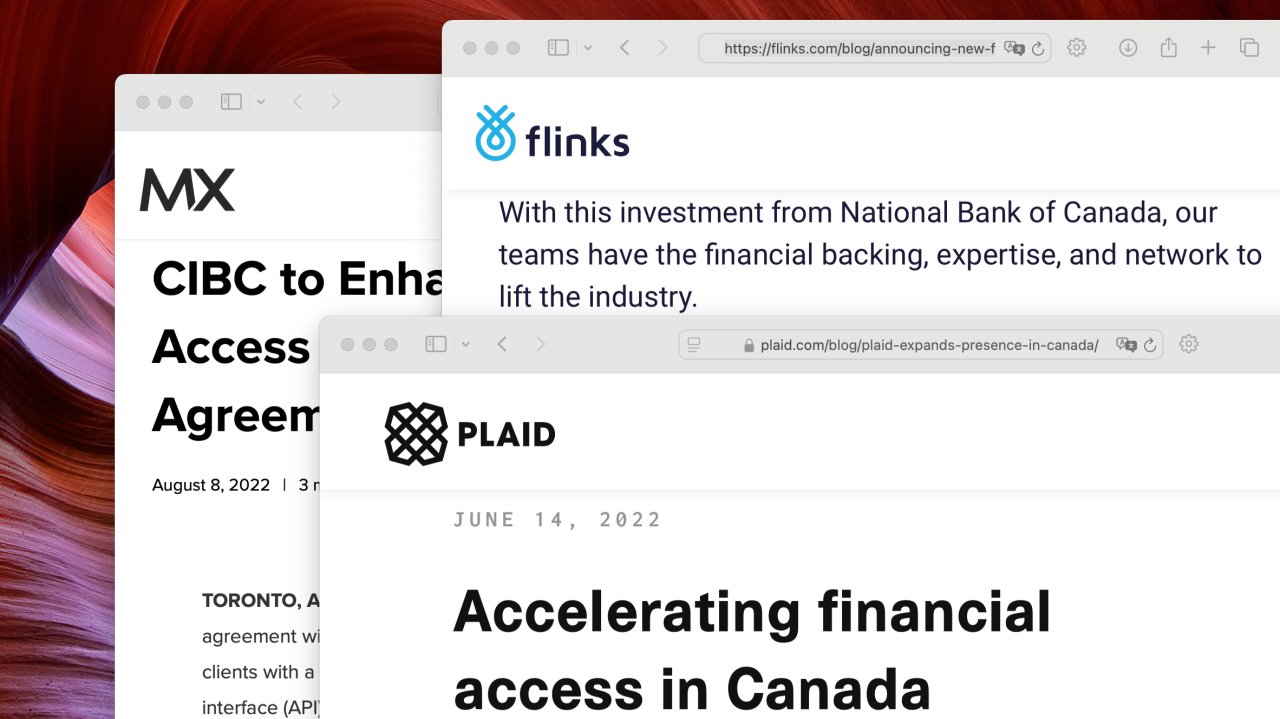
There were signs of market-driven progress in Canada that were encouraging: National Bank investing in Flinks in 2021; the agreement RBC and Plaid announced in June 2022; and the agreement I shared between CIBC and MX in August 2022. Ultimately, these developments did not accelerate private access to financial data in Canada in advance of regulated open banking. Did the banks deliver false hope to Canadian fintechs and set them on the wrong path? No.
Canadian fintechs may still be waiting for private API access today and regulated open banking in the distant future. But make no mistake — Canadian fintech founders are not setting roadmaps that depend on regulatory certainty or political action. They are heads down, building the future of financial services, competing asymmetrically against the large incumbent financial institutions.
Canadian consumers and businesses may not be clamouring for “consumer driven banking” or “data mobility rights” but they absolutely want better financial services. Canadian fintechs will not keep them waiting.